
LEGENDARY BANDS: BUFFALO SPRINGFIELD
Buffalo Springfield was a rock band formed in Los Angeles by Canadian musicians Neil Young, Bruce Palmer and Dewey Martin and American musicians Stephen Stills and Richie Furay.
The group, widely known for the song For What It's Worth, released three albums and several singles from 1966 to 1968. Their music combined elements of folk music and country music with British Invasion and psychedelic rock influences.
When I started working on this particular blog post I just happened to come across a paperback book I had purchased at a Woolworth store in 1970. The author of the book was Jerry Hopkins who was one of my favorite rock & roll writers. The book that Jerry Hopkins called The Rock Story stated that was all about The Names, The Faces, The Sound that turned on a generation.
My favorite chapter of Hopkins book was the final chapter: The Rise & Fall of a Group which was all about one of my favorite bands…Buffalo Springfield!

THE RISE & FALL OF A GROUP
By Jerry Hopkins
The lifespan of a popular musical group today is often measured in terms of records, not years, and listing the groups that have either disappeared in the past half year, or been through so many personnel changes as not to be recognized , is to compile a Who's Who of rock--including the Lovin' Spoonful, Cream, Traffic, Electric Flag, the Mamas and Papas, Country Joe and the Fish, Animals, Buffalo Springfield, Stone Ponys, Righteous Brothers, Big Brother and the Holding Company, The Yardbirds, The Byrds and Them (featuring Van Morrison).
The groups have shifted and crumbled like the earth above the San Andreas Fault, and the reasons for the slippage are numerous. Jefferson Airplane's drummer Spencer Dryden says, ‘Any time you’re dealing with emotions and business, which it always turns into because that's the structure we're using, you're going to have hassles.'
Dickie Davis, who was Buffalo Springfield's manager tells the whole story and the story of that group is the one that seems most typical. It begins in 1966 when Stephen Stills, a young blond, folksinger who played rhythm guitar, left Greenwich , left Greenwich Village for Los Angeles.
Dickie Davis said, ‘Stephen stayed with me when he first got to Los Angeles…Then a few works later he moved next door. We kept talking about forming a group. It would be with Van Dyke Parks. But that didn’t happen, so Steve sent for Richie…he called Richie on the phone. I paid for the call, not knowing the call was to New York…'
Richie Furay was another folk artist, another rhythm guitarist from Ohio. Davis recalls that ‘Richie stepped off the plane in a Brooks Brothers suit and a crewcut…Steve and I didn’t look like that at all. I thought right then nothing was going to happen…"
A few weeks later Stephen was in the living room of Barry Friedman, a former circus fire-eater and freelance publicist then organizing and producing bands for Randy Sparks. (Dick Davis had earlier been a road manager for the Back Porth Majority, one of Randy Sparks' groups.) They were busy on the telephone, using Randy Sparks' telephone credit card. (Friedman was planning to quit.) They found him – Ken Koblun and arranged to fly him to Los Angeles, where he began rehearsing with the group…but he couldn't hack the pressures and soon went back to Canada.

Shortly thereafter Richie and Stephen were caught in a Los Angeles traffic jam and noticed a hearse with Ontario plates ahead of them. Richie remembered a Canadian who's taught him a song called ‘Nowadays Clancy Can't Even Sing" and said to Stephen, ‘I’ll bet that's Neil Young!"
Neil Young provided the lead guitar the group needed and Bruce Palmer, who was in the hearse wit Neil, played bass. Barry Friedman told them about a drummer in the Dillards, a bluegrass group. He was Dewey Martin and that made the group.

The name of the band – Buffalo Springfield – came from a steamroller. There has been one of those steamrollers parked in front of Friedman's house on Fountain Ave in Hollywood.
‘In the beginning,’ Davis recalled, ‘Barry was a big help. He gave them money every day for hamburgers. They had a place to stay. Barry hustled them around. He managed to talk Eddie Ticknor (the Byrds’ manager) into putting the Buffalo on a five-date tour with the Byrds. I was running lights for the Byrds then and I went along. Buffalo Springfield was interesting, although you couldn't say there were good, even if David Crosby of the Byrds said so.'
After that Friedman (who took on the name Frazier Mohawk to become a record producer for Elektra Records) asked David to become involved in management. Davis said, ‘Barry had signed Stephen and Richie for management and now they were trying to sign them to Epic records. I happened to see the recording contracts. I guess it was a standard contract but being young and idealistic, I couldn’t accept it. The whole thing was atrocious. The royalties were only two and a half percent. There were clauses in the contract giving the band's name to the company. It came to me that I couldn't work with that contract and I really wanted to work with the group. I finally told the group, don't sign the contracts, they will take your name away from you if you over-sleep. In the end, I got the group and I lost Barry's friendship.'
Davis asked Chris Hillman of The Byrds if he would speak to Elmer Valentine, one of the owners of the Whiskey A Go Go about getting Buffalo Springfield booked into the Whiskey. Davis was running lights for Johnny Rivers but Valentine wasn't listening. Davis still pressed Elmer to get a slot for Buffalo Springfield. In short order the Buffalo Springfield went into the Whisky as the ‘second group’ for six weeks. Meanwhile, Davis 'bopped around town between Dunhill Records and Warner Brothers Records along with a couple of other labels.
Warner Brothers was offering a ten-thousand-dollar advance, and Davis accepted (verbally) Dunhill's five. He didn't know what to do so he called two friends, Charlie Greene and Brian Stone, who had been the managers of Sonny and Cher and then they had the Daily Flash, a group from the Pacific Northwest and Bob Lind who had a hit with Elusive Butterfly. They said nothing was firm until contracts were signed. Davis told Warner Brothers they had a deal but he first have to tell Dunhill ‘No’.
That night Greene and Stone called, saying they wanted a crack at it so Davis took the group to meet the members of Buffalo Springfield and Brian and Charlie charmed them. The band did their show and the band members said, ‘This is our kind of people; they should produce us and manage us and publish us…’ Davis thought so too.
After things had settled, Davis suddenly realized that the band ended up being contracted to Atlantic Records. The money was in the bank…12 Thousand! Plus…Green & Stone had given the band all their instruments.
Meanwhile, the Buffalo Springfield were tearing up the crowds at the Whiskey. Everybody in town was coming to hear the band. In three weeks, Richie had turned into a fireball. Davis was surprised to see that ‘Richie would bounce from one end of the stage to the other on his tiptoes backward and he would be playing and screaming and it meant something. It was his stage presence that would develop the Buffalo Springfield technique of splitting from the microphone the minute the verses were over and hitting the microphone just as the words were starting again. The rest of the time being nowhere near the microphones. It was characteristic of the band on stage.
Davis said, 'Bruce Palmer was the real star though…playing the most incredible bass ever heard; warped neck, bad pickups , only one knob worked and four bottom E guitar strings, all tuned low, everything on the amp turned to bass. Despite this, Bruce was incredible.
We had decided Gold Star was not good for a vocal sound so we took our four-track recording over to Columbia and played it back on their eight-track, and as a consequence we lost a generation on nearly everything on the first album…sometimes two generations. We did some vocals there, then we did a final mix-down at Gold Star. And then we went to Columbia again, re-recording as many cocals as we could. By now, Atlantic was screaming: ‘You have to have a November release or we can’t get it out for Christmas!' They gave us two weeks. The pressure was on.
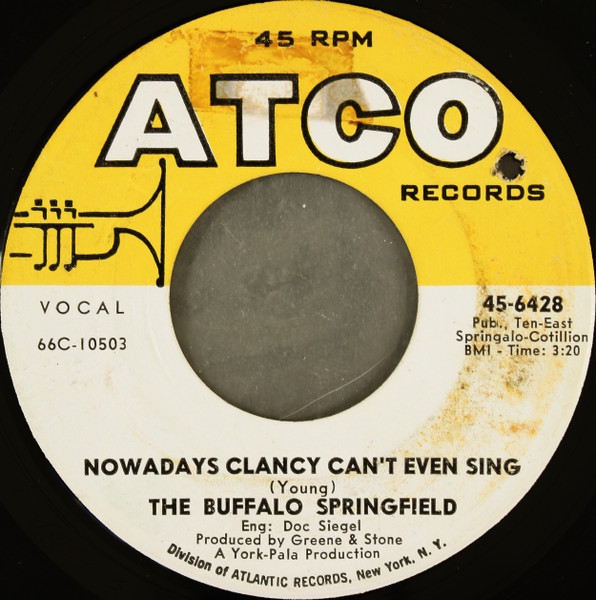
In the midst of this, the group's first single was released--the song Neil had taught Richie so long ago, Nowadays Clancy Can't Even Sing. It's release as the A-side of the first single infuriated the band.
Nowadays Clancy Can't Even Sing was supposed to be the B-side and the A-side was supposed to be Go and Say Goodbye. It was pressed that way and sent to the distributors. Then the next day we got a call that due to heavy distributor demand, the A-side was switched to ‘Clancy’. We said fine; we were convinced it was going to be a hit, because we figured distributors wouldn't have bothered to demand anything if they didn't think it was going to be a hit, right? Well…we were lied to a lot of things in those days.
Soon enough, the band was nurturing growing dissatisfaction with its managers. Stephen Stills even went to Barry Friedman asking him to take over as producer…Somehow, Greene and Stone stayed on and the LP was finished.
Davis said, “The band got a hold of a two-sided master dub of the album and ran over to Steve Sanders' house, where there was the best sound equipment we knew about. At the time, Sanders was working for the Mamas and Papas and John Phillips was there when the band arrived. The band put the dub on the record player and I could have hidden for shame. All of the levels were so far off from one track to the next, it sounded like they were from two different albums. There were places where harmony parts were practically unapparent.”
The band wanted to go back to the studio so they could do it again but the album ended up being released anyway.
As the Buffalo Springfield's album was released, the money ran out. The band managed to be second-billed to the Turtles in Redondo Beach.
Somehow Stephen found a small club in Sausalito that would let them play. So for several weeks the band jammed at a club called the Ark, alternating sets with a new group from San Francisco called Moby Grape but the band wasn't going anywhere.
Recently there had been what the newspapers called riots on the Sunset Strip. The kids had been protesting a ten o'clock curfew. The cops had said it was a riot. Stephen came away from his friend's ranch with a song called For What It's Worth.
For What It's Worth became the group's first, and only, real national hit, going to Number Seven position on the record charts following a slow fourteen week climb up the charts which led to the band to appear on Hollywood Palace.
BUFFALO SPRINGFIELD >
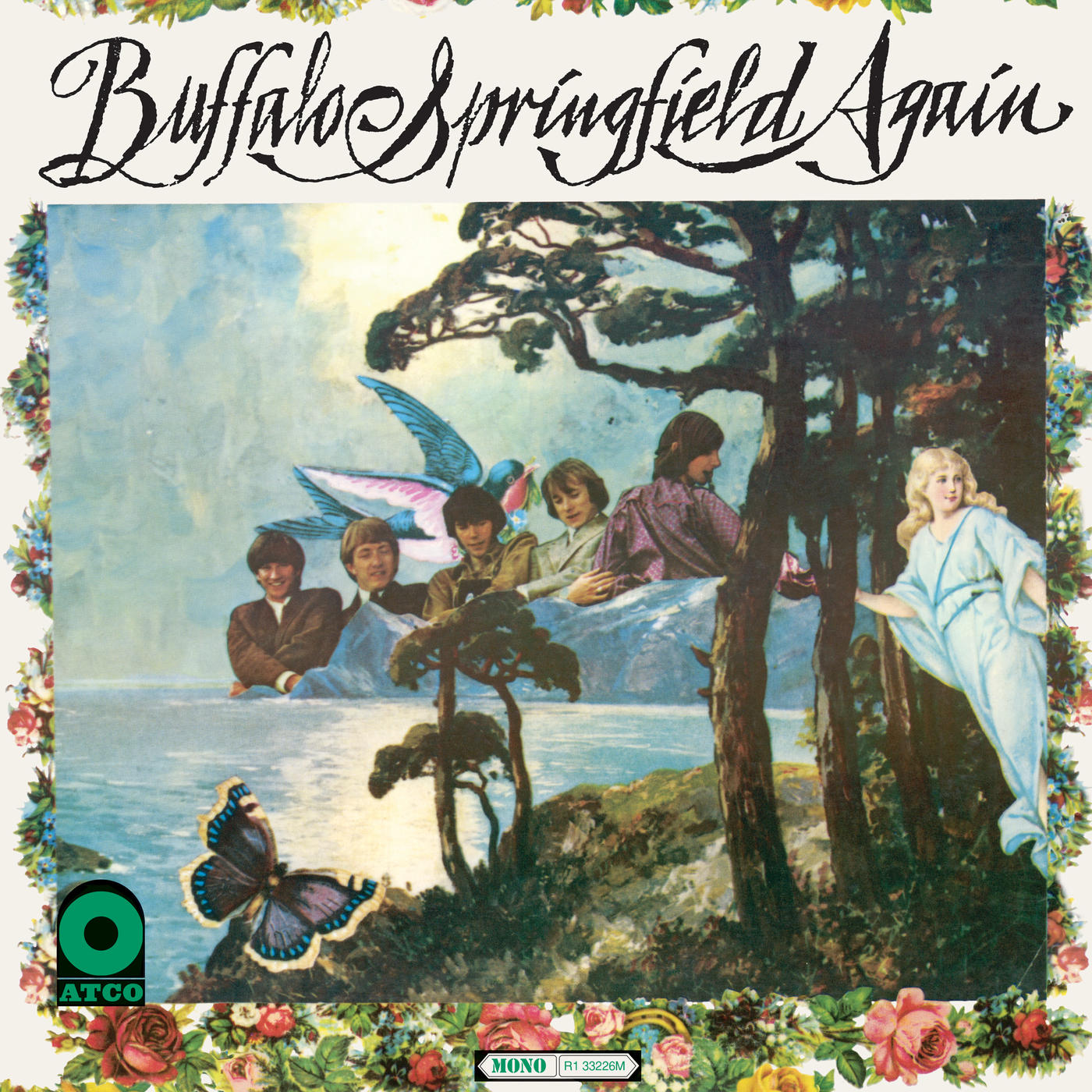
BUFFALO SPRINGFIELD AGAIN
I immediately fell in love with this particular album. The songwriting and performances overwhelmed me due to the fact that each day when I played this album I always seemed to find some new and exciting on this slab of vinyl.
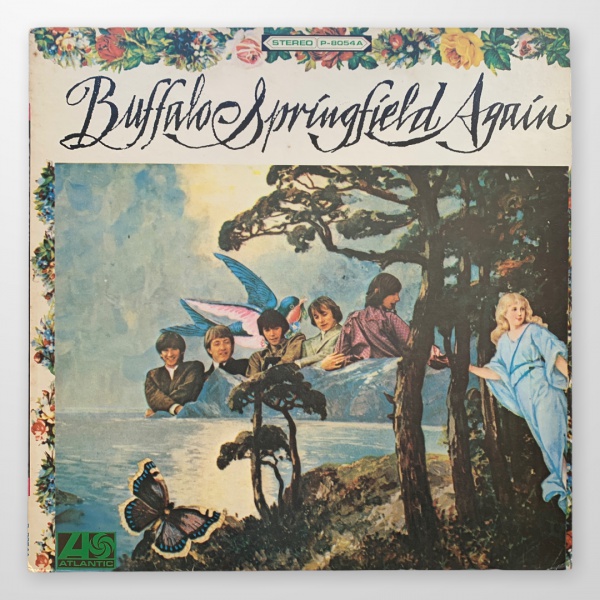
Album Art by the one & only Eve Babitz
Released in 1967 on Atco Records, Buffalo Springfield Again was the band's second album release and, to this day, I find it to be their finest record. When I played the album this morning I found that the album has not only stood the test of time, it remains a masterpiece.
Buffalo Springfield Again, the second album by the highly influential Los Angeles band featuring Stephen Stills, Neil Young, Richie Furay, Bruce Palmer and Dewey Martin, was released in November 1967. It peaked at #44 on the Billboard LPs chart but has had a lasting impact, with such timeless songs as “Mr. Soul,” “Bluebird,” “A Child’s Claim to Fame” and “Expecting to Fly” among its tracks.
Buffalo Springfield Again was a defining moment in L.A. music history; like Brian Wilson before them, the Buffalo Springfield meshed songcraft with new recording techniques, elevating their music to a rarefied state of creative music. The album was largely recorded at Columbia and Sunset Sound studios, which had recently been equipped with 8-track tape machines.
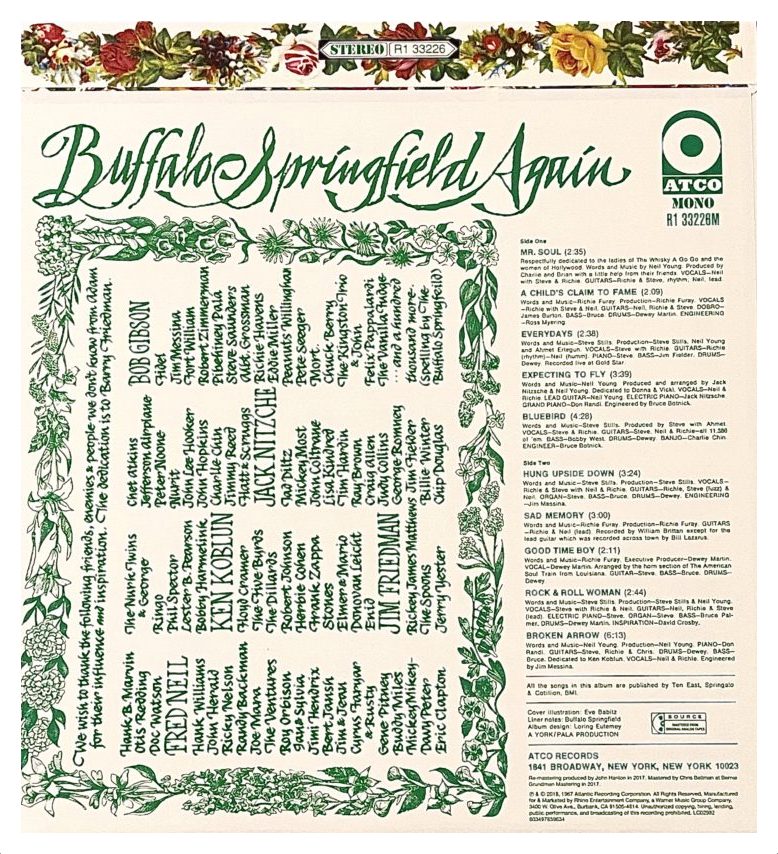
Rear Cover
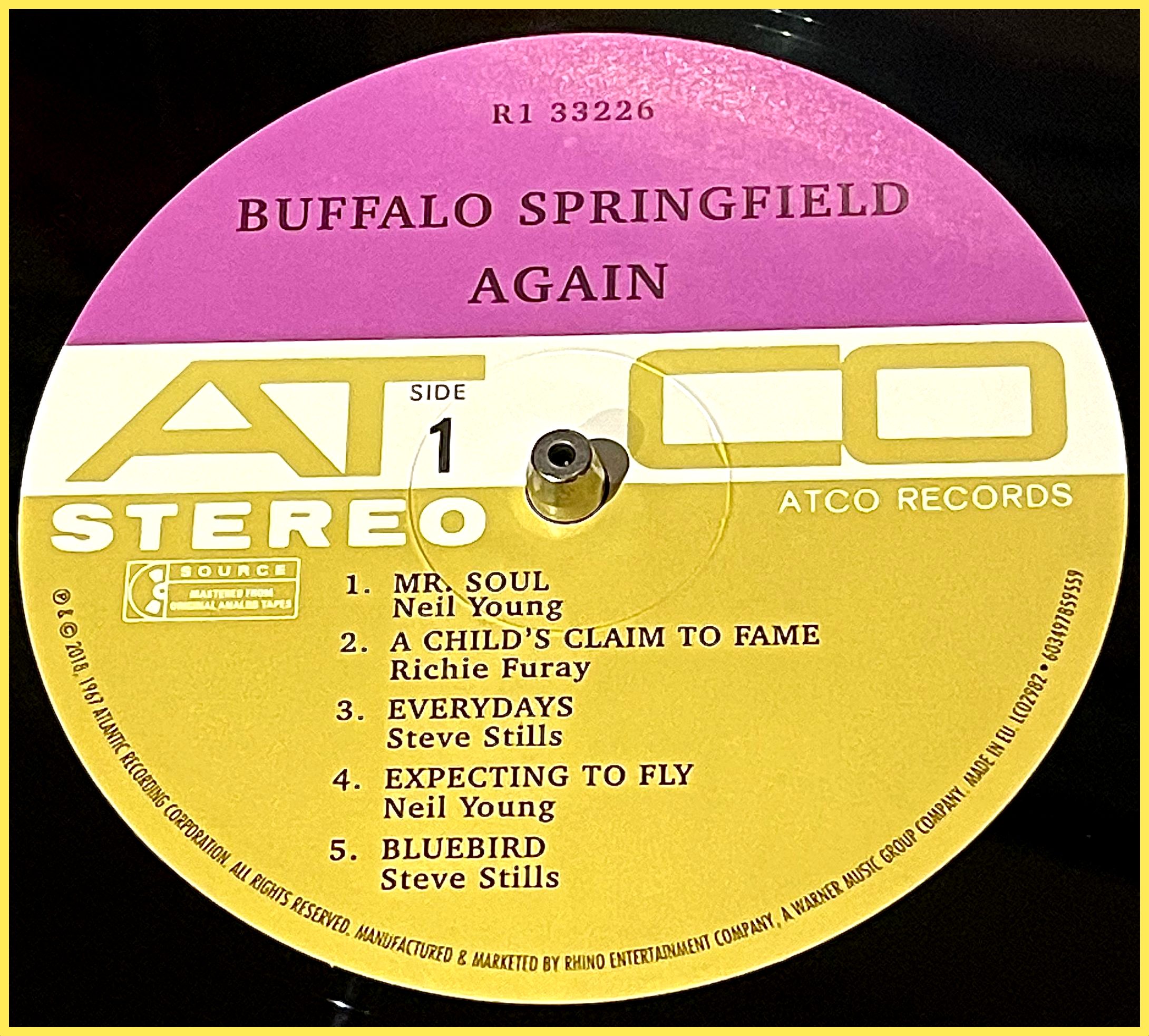
WHO PLAYED WHAT:
- Stephen Stills – vocals, guitars, keyboards
- Neil Young – vocals, guitars
- Richie Furay – vocals, rhythm guitar
- Bruce Palmer – bass guitar
- Dewey Martin – vocals, drums
Session Musicians
- Russ Titelman – guitar on "Expecting to Fly"
- Doug Hastings – guitar on "Rock & Roll Woman"
- Chris Sarns – guitar on "Broken Arrow"
- James Burton – Dobro on "A Child's Claim to Fame"
- Charlie Chin – banjo on "Bluebird"
- Jack Nitzsche – electric piano on "Expecting to Fly"
- Don Randi – organ on "Broken Arrow", piano on "Expecting to Fly" and "Broken Arrow", harpsichord on "Expecting to Fly"
- Jim Fielder – bass on "Everydays"
- Bobby West – bass on "Bluebird"
- Carol Kaye – bass on "Expecting to Fly"
- Harvey Newmark – bass on Jazz theme of "Broken Arrow"
- Jim Gordon – drums, vibes, timpani on "Expecting to Fly"
- Hal Blaine – drums on Jazz theme of "Broken Arrow"
- Jim Horn – clarinet on Jazz theme of "Broken Arrow"
- The American Soul Train – horns on "Good Time Boy"
- Merry Clayton, Brenda Holloway, Patrice Holloway, Gloria Jones, Sherlie Matthews, Gracia Nitzsche – backing vocals on "Expecting to Fly"
Production
Producers – Brian Stone (Track 1), Charles Greene (Track 1), Neil Young (Tracks 2, 3, 4, 9, 10), Stephen Stills (Tracks 3, 5, 6, 9), Ahmet Ertegun (Tracks 3, 5), Jack Nitzsche (Track 4), Jim Messina (Track 6), Richie Furay (Track 7), Dewey Martin (Track 8)
Recording Engineers – Bruce Tergesen (Track 1), Ross Myerling (Tracks 2, 6), Jim Messina (Tracks 2, 6, 8, 9, 10), James Hilton (Track 3), Bruce Botnick (Tracks 4, 5), William Brittan (Track 7), Bill Lazarus (Tracks 7, 10), Tom May (Track 10)
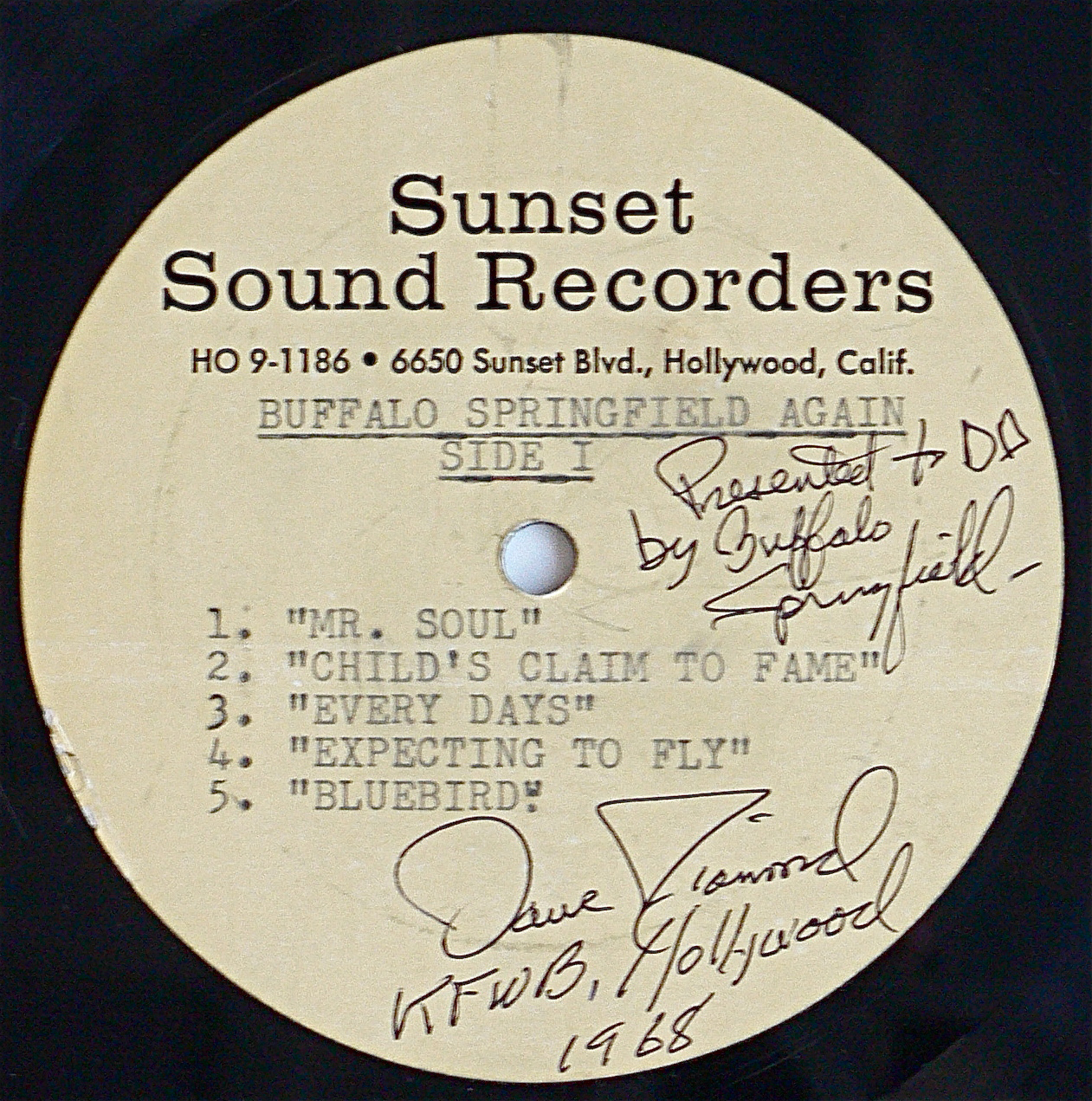
Here's some info from the
Best Classic Bands website:
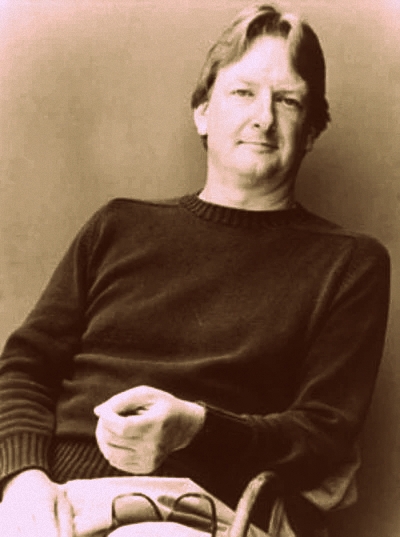
Denny Bruce
In an interview with Denny Bruce (a producer & manager) stated that in 1967, Neil and the band left Gold Star to do Buffalo Springfield Again. "I remember Stephen being outraged that co-producer Jack Nitzsche was like Yoko Ono fucking with the band. Neil finally said, ‘I’m gonna use some other players.’ Before the album began, I went up to Neil’s cabin. It was one of those things where you walk in and Neil had his jumbo acoustic 12-string guitar and he’s halfway through a song that turned out to be Expecting to Fly. It’s pre-cassette days, and it’s like he doesn’t want to forget where he’s at in this song. So I sit there for a good hour. He kept starting and stopping and trying other chord changes that most musicians wouldn’t go to. There was always a different tuning and Neil was also really good at using various time changes.
Neil started talking about Expecting To Fly and said, “I hear it as a song for the Everly Brothers.” Jack Nitzsche and I went to over to Neil’s and heard the song and both of us agreed it was great. Then Jack said, “Fuck the Everlys. This is for Neil Young. We can make a great record.” Jack also heard Mr. Soul and really liked it because it was all about the lyrics. Jack knew Neil would eventually become a solo star.
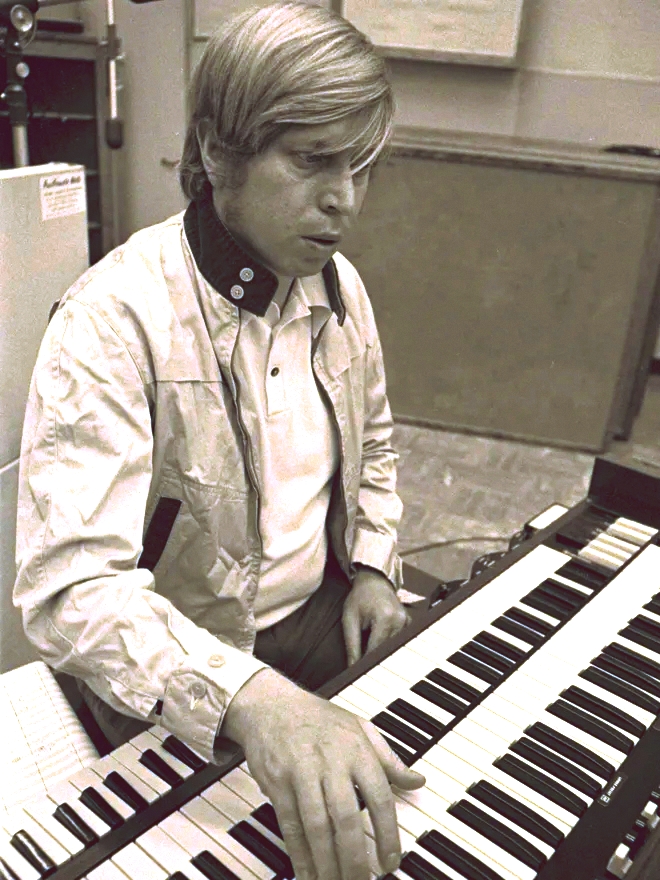
Don Randi
Don Randi (pianist): "Jack Nitzsche called me to play keyboard on some dates in 1967 at Sunset Sound. I picked out the piano for the studio. I didn’t realize it was for Buffalo Springfield. I thought it was for a Neil Young (solo) album, ’cause he was supposed to be breaking away and going on his own. (Drummer) Hal Blaine and (saxophonist/flutist) Jim Horn are on the track. I played piano and organ. When Jack and Neil asked me to play on the end part of “Broken Arrow,” they were both waving me on to keep playing. I kept looking up at them, “Are you ever gonna tell me to stop?”
(Guitarist) Russ Titelman, (bassist) Carol Kaye and (drummer) Jim Gordon are on it. I had some little head chart arrangement to work from and another of the tunes might have been sketched. It was pretty wide open with the chord changes. All you had to do was hear Neil sing it with an acoustic guitar and you sat there, “Oh my goodness.” He was so talented. Jack and Neil were a team and had a mutual admiration society. Recording with them was easy. Neil wrote cinematically and Jack arranged his own records cinematically. Neil was smart enough to know what he wanted and knew how to get it. And Neil had [Atlantic Records president] Ahmet Ertegun in his corner.
BRUCE BOTNIK
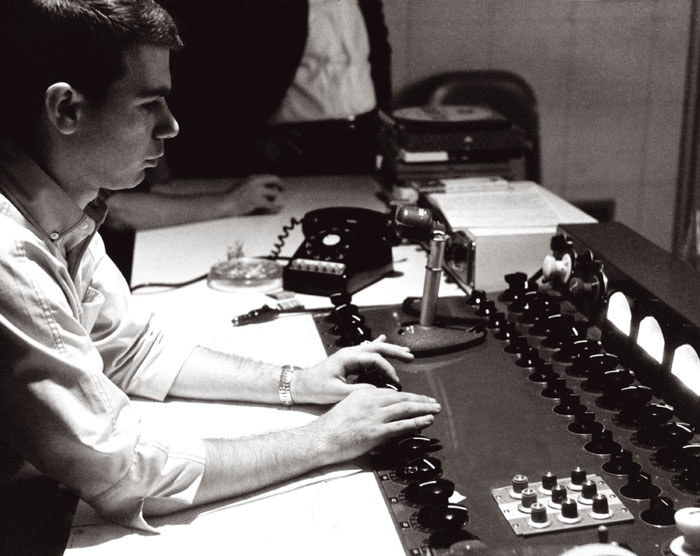
Bruce Botnick (engineer): Sunset Sound was very unique. Tooti Camarata (one of the designers of the studio) did something that nobody had done in this country: He built an isolation booth for the vocals. That’s one of the things that worked so well for Jack Nitzsche because we were able to put six strings in there and get full isolation live. With the strings being in the large isolation booth, the drums didn’t suffer, so we were able to make tighter and punchier rhythm tracks than any of the other studios in town were able to do.
Everybody did everything live in those days. You did your vocals live. You did your strings and your brass live. And the rhythm section. And this was a big deal. Then add to it the amazing echo chamber that Alan Emig designed. It still sounds incredible!
On Buffalo Springfield Again, the songs were so strong, and so were the performances. We had two lead guitar players between Stills and Young, two massively prolific writers between the two of them, and there was constant tension between the two, creative tension that would manifest itself in either one of them losing it for a few minutes. And then they would get back together and hug like crazy and do the songs. It was about performance. We’d be recording a song, and Stephen would say to Neil, “Hey, man, I just got a new idea for a song.” Or, “It isn’t finished but what do you think?” And Neil would say, “Hey, that’s great.” This went on constantly.

COMPLETE ALBUMS COLLECTIONS
Tracks
Disc One: Buffalo Springfield
(Mono Version)
"Go and Say Goodbye"
"Leave"
"Nowadays Clancy Can't Even Sing"
"Hot Dusty Roads"
"Everybody's Wrong"
"Flying on the Ground Is Wrong"
"Burned"
"Do I Have to Come Right Out and Say It"
"Baby Don't Scold Me"
"Out of My Mind"
"Pay the Price"
Disc Two: Buffalo Springfield
(Stereo Version)
"For What It's Worth"
"Go and Say Goodbye"
"Sit Down I Think I Love You"
"Nowadays Clancy Can't Even Sing"
"Hot Dusty Roads"
"Everybody's Wrong"
"Flying on the Ground Is Wrong"
"Burned"
"Do I Have to Come Right Out and Say It"
"Leave"
"Out of My Mind"
"Pay the Price"
Disc Three: Buffalo Springfield Again
(Mono Version)
"Mr. Soul"
"A Child's Claim to Fame"
"Everydays"
"Bluebird"
"Hung Upside Down"
"Sad Memory"
"Good Time Boy"
"Rock & Roll Woman"
Disc Four: Buffalo Springfield Again
(Stereo Version)
"Mr. Soul"
"A Child's Claim to Fame"
"Everydays"
"Expecting to Fly"
"Bluebird"
"Hung Upside Down"
"Sad Memory"
"Good Time Boy"
"Rock & Roll Woman"
"Broken Arrow"
Disc Five: Last Time Around
(Stereo Version)
"On The Way Home"
"It's So Hard to Wait"
"Pretty Girl Why"
"Four Days Gone"
"Carefree Country Day"
"Special Care"
"The Hour of Not Quite Rain"
"Questions"
"I Am a Child"
"Merry-Go-Round"
"Uno Mundo"
"Kind Woman"
Personnel
Buffalo Springfield:
- Richie Furay – Guitar, Vocals, Vocals (background), Producer
- Dewey Martin – Clarinet, Drums, Horn, Saxophone, Vocals, Executive Producer
- Jim Messina – Bass, Producer, Engineer
- Bruce Palmer – Bass
- Stephen Stills – Organ, Bass, Guitar, Percussion, Piano, Piano (Electric), Tambourine, Vocals, Vocals (background), Handclapping, Producer, Remixing
- Neil Young – Guitar, Harmonica, Piano, Arranger, Vocals, Vocals (background), Producer, Remixing
Joel Bernstein – Artwork, Compilation, Photography, Research, Text
Hal Blaine – Drums
Don Blake – Mixing
Bruce Botnick – Engineer
William E Brittan – Engineer
Gary Burden – Art Direction, Design
James Burton – Dobro
Jimmy Karstein – Drums
Charlie Chin – Banjo
Merry Clayton – Choir, Chorus
David Crosby – Backing Vocal on "Rock & Roll Woman"
Richard Davis – Bass
Ahmet Ertegun – Producer
Cyrus Faryar – Percussion
Jim Fielder – Bass
James Gordon – Strings, Horn (English)
Jim Gordon – Drums, Tympani [Timpani], Vibraphone
Charles Greene – Producer
Doug Hastings – Guitar
Jessie Hill – Drums, Tympani [Timpani]
Jim Hilton – Engineer
Brenda Holloway – Choir, Chorus
Patrice Holloway – Choir, Chorus
Jim Horn – Clarinet
Carol Kaye – Banjo, Bass, Dobro, Fiddle, Piano, Strings, Drums, Horn, Vibraphone
Bill Lazarus – Engineer
Gary Marker – Bass
Sherlie Matthews – Choir, Chorus
Tom May – Engineer
Buddy Miles – Drums
Tim Mulligan – Remixing
Harvey Newmark – Bass
Gracia Nitzsche – Choir, Chorus
Jack Nitzsche – Arranger, Piano (Electric), Producer
Don Randi – Organ, Piano, Harpsichord
Mac Rebennack – Piano
Stan Ross – Engineer
Doc Siegel – Engineer
Armin Steiner – Engineer
Brian Stone – Producer
Jeromy Stuart – Calliope, Harpsichord, Bells
Bruce Tergesen – Engineer
Russ Titelman – Guitar
Bobby West – Bass
Rusty Young – Pedal Steel