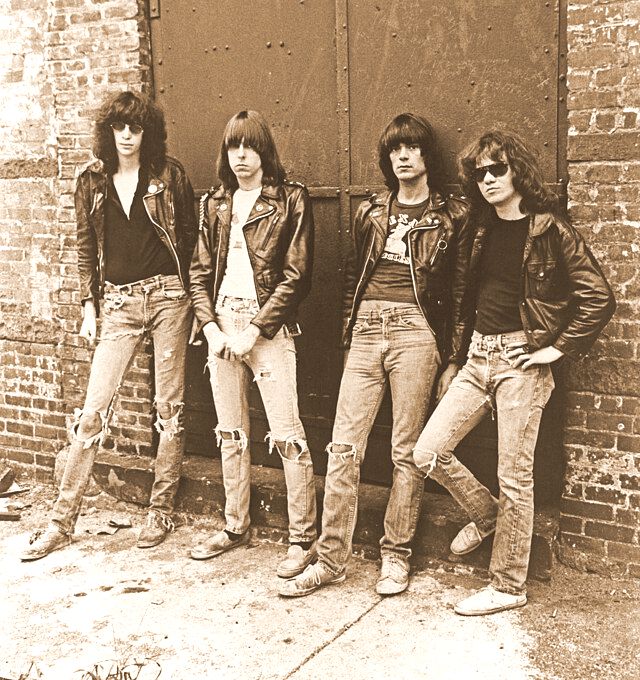
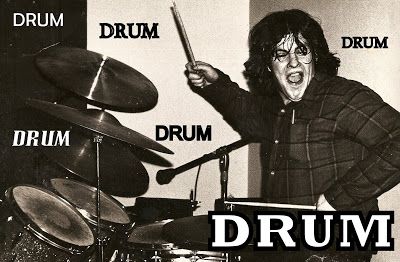
Today's Blog Post is dedicated with much love to BILLY “THE MOUNTAIN” CAIRNS who turned me on to the RAMONES while we were college students @ The University of Dayton.

HOW THE RAMONES BECAME THE RAMONES
One day Tommy Ramone asked Johnny and Dee Dee Ramone why they didn't start a band.
Jan 23, 1974: Johnny left work at Paramount Plaza (1633 Broadway) with Dee Dee Ramone who worked in the mailroom.
They ended up heading to Manny’s Music (156 W 48th St) on Music Row nearby. For $50, Johnny Ramone bought a new Mosrite guitar and Dee Dee bought a new bass guitar.
In no time at all, Johnny and Dee Dee started practicing at The Glover Cleveland in Forest Hills. Out of the blue, Johnny and Dee Dee decided to form a band. Dee Dee named the band The Ramones after Paul Ramon (Paul McCartney's 1960 stage name).

Suddenly Dee Dee soon blew his voice and had to be replaced by Joey as lead singer, who was replaced on drums by Tommy. To complete their trio, Johnny reluctantly recruited drummer Joey Ramone. Tommy Ramone became their surrogate manager.
The Ramones had their first rehearsal on January 27, 1974, at Performance Studios (23 E 20th St) where Blondie and New York Dolls had also rehearsed.
THE RAMONES FIRST SETLIST
I Don't Wanna Go Down To The Basement
I Don't Wanna Walk Around With You
Now I Wanna Sniff Some Glue
I Don't Wanna Be Learned/I Don't Wanna Be Tamed
I Don't Wanna Get Involved With You
I Don't Like Nobody That Don't Like Me
Succubus
The Ramones' debut took place on March 30, 1974 at Performance Studios. The band was watched by only 8 or 9 people.
In the crowd was Richard Hell of Television as well as Debbie Harry and Chris Stein of Angel and the Snake (Blondie).
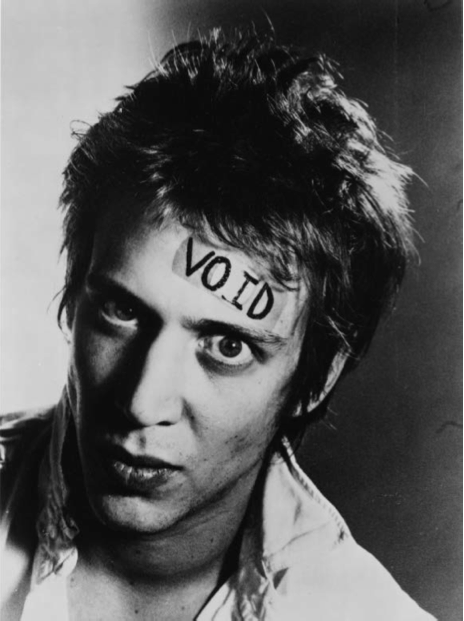
Richard Hell
“I wondered, 'Are these guys serious?' recalled Richard Hell. ‘Is this an act? If it is, this is great! It’s like being in the circus!”
:max_bytes(150000):strip_icc()/tommy-ramone-ba13df84824f4dd69c9631ae71d9c2ec.jpg)
Tommy Ramone
Johnny and Dee Dee started practicing at The Grover Cleveland (67-38 108th St) in Forest Hills.
One day Tommy Ramone asked why Johnny and Dee Dee Ramone did not start a band.
Tommy Ramone and future Ramones roadie Monte Melnick managed Performance Studios. Mickey Leigh became the first Ramones roadie soon to be joined by Monte.

The New York Dolls home court Mercer Arts Center (est. 1971). The Mercer built in 1873 @ Broadway Central Hotel ended up collapsing on August 3, 1973. The destruction of the Mercer Arts Center caused the local music scene to shift to CBGB (315 Bowery) which opened in December 1973.
Television debuted at CBGB on March 31, 1974, after convincing owner Hilly Kristal to create a stage there. Television was soon joined by Patti Smith. CBGB had stood for Country Bluegrass Blues. The music format changed but the name was kept. Dee Dee Ramone happened to know about CBGB because he had auditioned for Television, losing out to Richard Lloyd. CBGB was in a long shot destination inside a Bowery Flophouse. Outside were winos and corpses all along the Bowery.
The Ramones debuted at CBGB on August 16, 1974. The opening act was Angel and The Snake, soon to be renamed Blondie.

“CBGB's was a slum bar,” said Joey Ramone. “There weren't any customers. I remember walking in with the sawdust on the floor, with the dog shit all over the place, playing a couple of songs. There was just a bartender and his dog.”

Alan Vega
“I caught the Ramones first gig and I ended up laughing my ass off,” said Alan Vega of Suicide (1970). “I thought they were great.”

Johnny Ramone: “I told Dee Dee that this guy's sick, and that if we can fool him, maybe we can fool more people. Sure enough, a few more started showing up each time.”
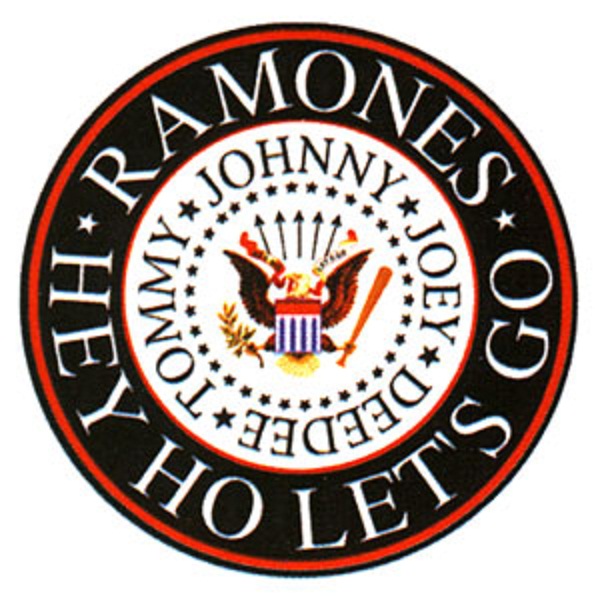
The other fan at the first show might have been Arturo Vega, no relation to Alan Vega. Arturo soon designed. The Ramones' classic eagle logo and became their art director. He saw all but two of their 2,263 concerts (1974-1996).

The Ramones still had no more than 15 fans at CBGB in July 1975. Most followers were from Arturo Vega's circle or from Forest Hills (Queens), the 8 or 9 Ramones' pals who first gather at The Ramp outside Thorneycroft Apartments. The Forest Hills contingent helped put up posters at local Universities and became the core of the crowd.

Future 1975-1980 manager Danny Fields, the first openly gay man Johnny Ramone knew, then still rare in music, also thought The Ramones were Mexican (or Puerto Rican). The Ramones' largest fan base was ultimately in Latin America by 1996.
Until early 1975, Danny Fields dismissed them as a Latin band. But rock critic Lisa Robinson eventually relented to Tommy's Ramone's barrage of promo. She was floored by their 15 minute set at CBGB's.
Lisa then pushed Danny to see them at CBGB, which he did on a Monday & Tuesday (April 14-15, 1975). Danny immediately fell in love with The Ramones and became their manager. He then got them signed by Sire founder Seymour Stein by Oct 1975. The Ramones doubled their crowd to 30 people at CBGB.

There was no name for this DIY music in Manhattan until Punk magazine came along in January 1975 and ended up covering the entire scene. Punk magazine was named for the Kojak line, you're a punk.

Lester Bangs
Lester Bangs had been writing for Creem magazine until moving to NYC in 1976. Bangs then became part of the CBGB scene. Bangs fronted his first band at CBGB for Easter weekend in 1977 and then he went on to front a band called Birdland (1977-1979) with Mickey Leigh on guitar.
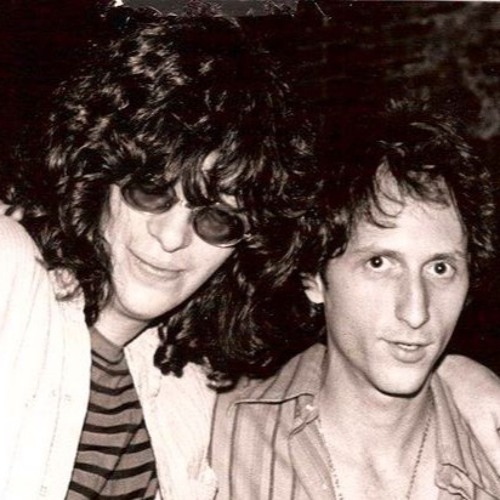
Joey Ramone & Mickey Leigh
Mickey Leigh had been in a 1969-1971 rock act with Johnny Ramone. That's how Johnny met Mickey's brother Joey Ramone.
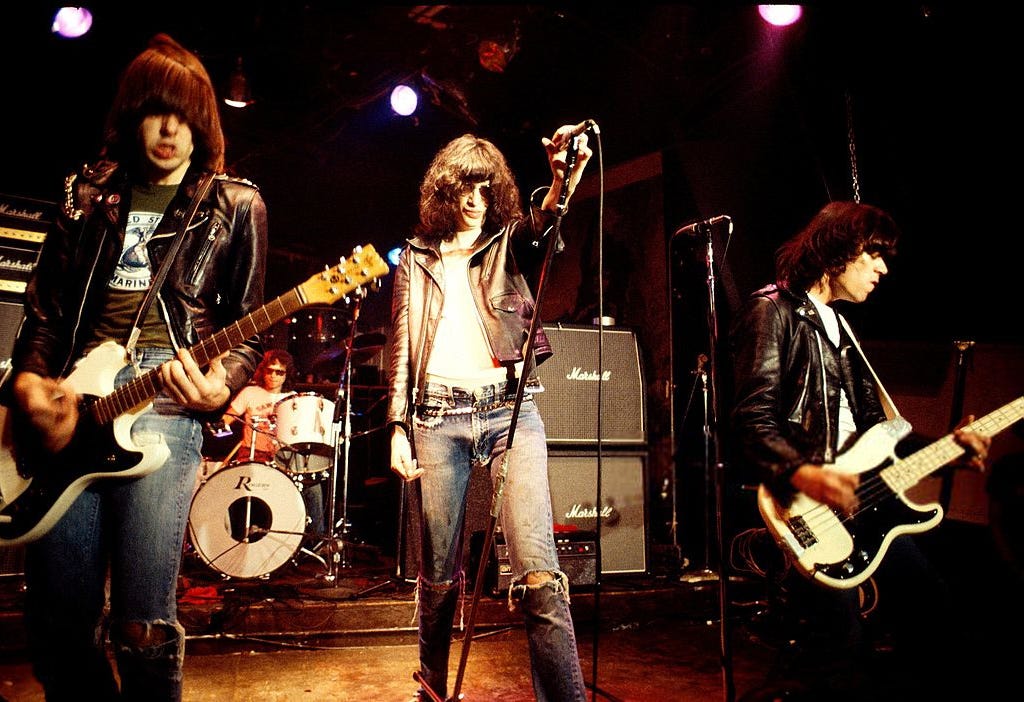
The Ramones returned to Performance Studios in 1974 Nov 16, Dec 7 & 20 and 1975 Feb 28, March 1, April 11 & 25 and Sept 12 - 13.
In February 1976, The Ramones recorded their debut album, Ramones. Of the fourteen songs on the album, the longest, I Don't Wanna Go Down to the Basement, barely surpassed two and a half minutes. While the songwriting credits were shared by the entire band, and each member did contribute some writing, much of the writing was done by Dee Dee.
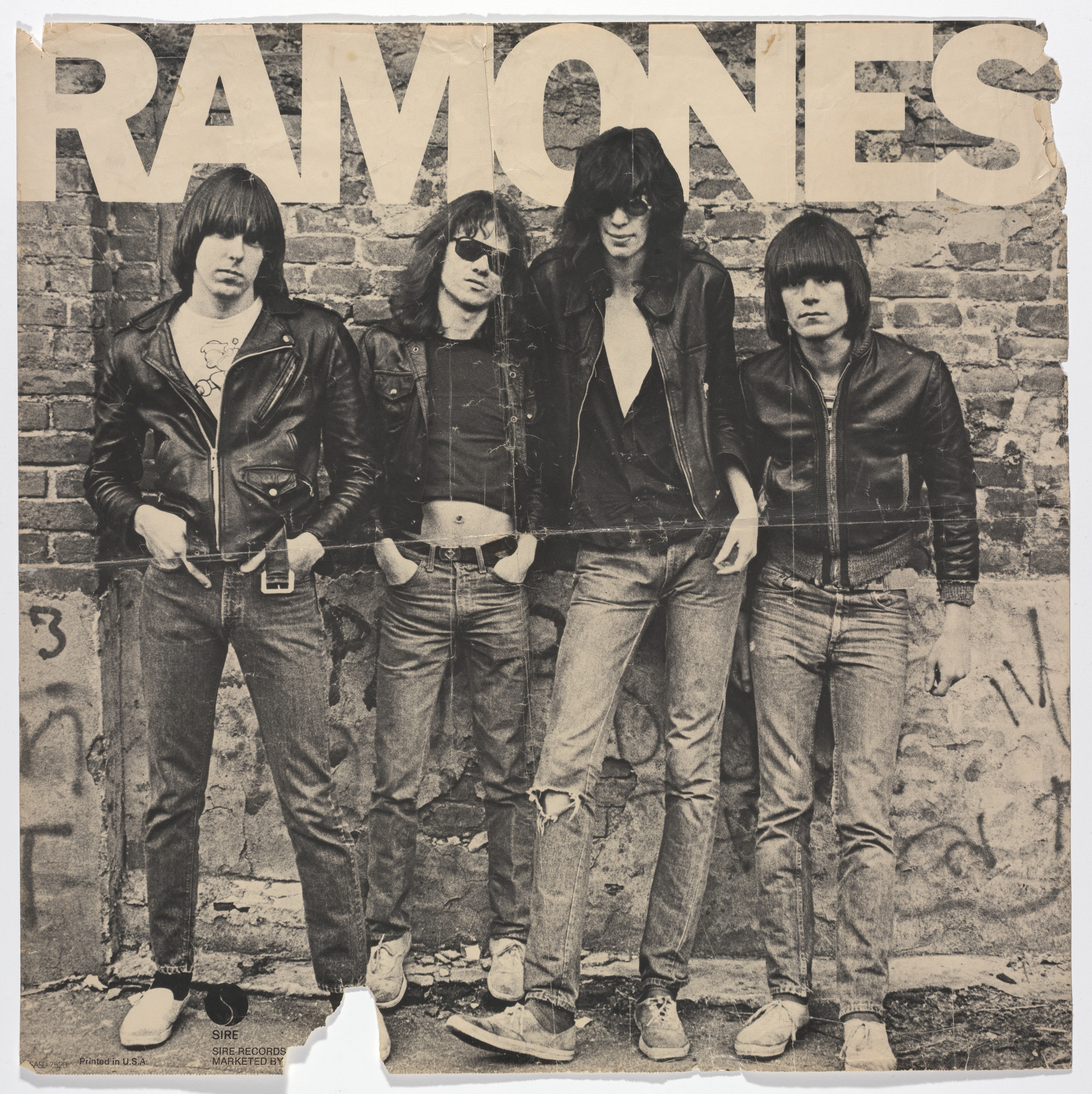
The Ramones album was produced by Sire's Craig Leon, with Tommy as associate producer, on an extremely low budget of about $6,400 and released in April. The now iconic front cover photograph of the band was taken by Roberta Bayley, a photographer for Punk magazine. Punk, which was largely responsible for codifying the term for the scene emerging around CBGB, ran a cover story on the Ramones in its third issue, the same month as the album's release.
The Ramones debut album was greeted by rock critics with glowing reviews. In Rolling Stone, Paul Nelson described it as "constructed almost entirely of rhythm tracks of an exhilarating intensity rock & roll has not experienced since its earliest days." Characterizing the band as "authentic American primitives whose work has to be heard to be understood", he declared, “It is time popular music followed the other arts in honoring its primitives.” Newsday's Wayne Robbins simply anointed the Ramones as “the best young rock 'n' roll band in the known universe.”
Despite Sire Records high hopes for it, Ramones was not a commercial success, reaching only number 111 on the Billboard album chart. The two singles issued from the album, Blitzkrieg Bop and I Wanna Be Your Boyfriend, failed to chart.
It was not until the Ramones made a brief tour of England that they began to see the fruits of their labor; a performance at the Roundhouse in London on July 4, 1976, with The Stranglers supporting the Flamin' Groovies, organized by Linda Stein, was a resounding success. Their Roundhouse appearance and a club date the following night—where the band met members of the Sex Pistols and the Clash—helped galvanize the burgeoning UK punk rock scene.
The Flamin' Groovies/Ramones double bill was successfully reprised at the Roxy Theatre in Los Angeles the following month, fueling the punk scene there as well. The Ramones were becoming an increasingly popular live act—a Toronto performance in September energized yet another growing punk scene.
Their next two albums, Leave Home and Rocket to Russia, were released in 1977. Both were produced by Tommy and Tony Bongiovi, the second cousin of Jon Bon Jovi.
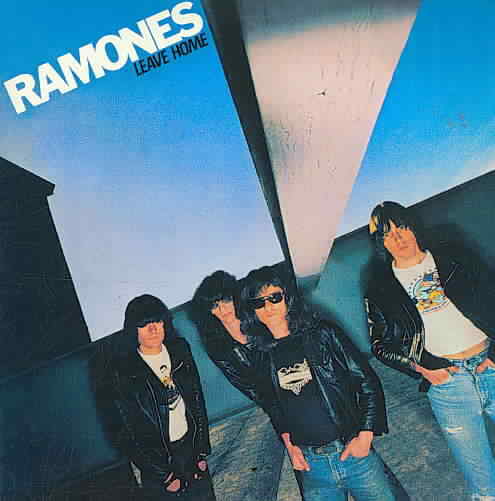
Leave Home met with even less chart success than Ramones, though it did include Pinhead, which became one of the band's signature songs with its chanted refrain of "Gabba gabba hey!"
Leave Home also included a fast-paced cover of the oldie California Sun, written by Henry Glover & Morris Levy, and originally recorded by Joe Jones, though the Ramones based their version on the remake by the Rivieras.
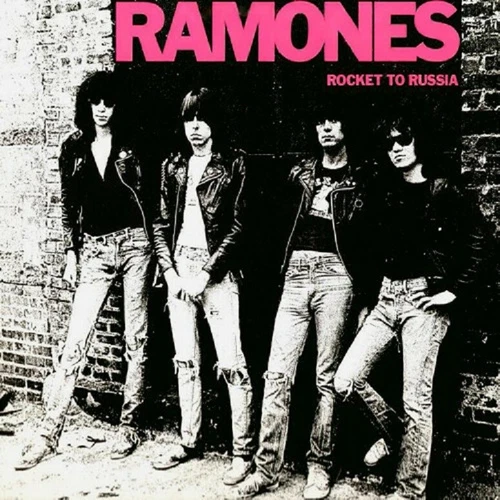
Rocket to Russia was the band's highest-charting album to date, reaching number 49 on the Billboard 200.
In Rolling Stone, critic Dave Marsh called it "the best American rock & roll of the year". The album also featured the first Ramones single to enter the Billboard charts (although it only got as high as number 81): Sheena Is a Punk Rocker. The follow-up single, Rockaway Beach, reached number 66—the highest any Ramones single would ever reach in America. Huzzah!
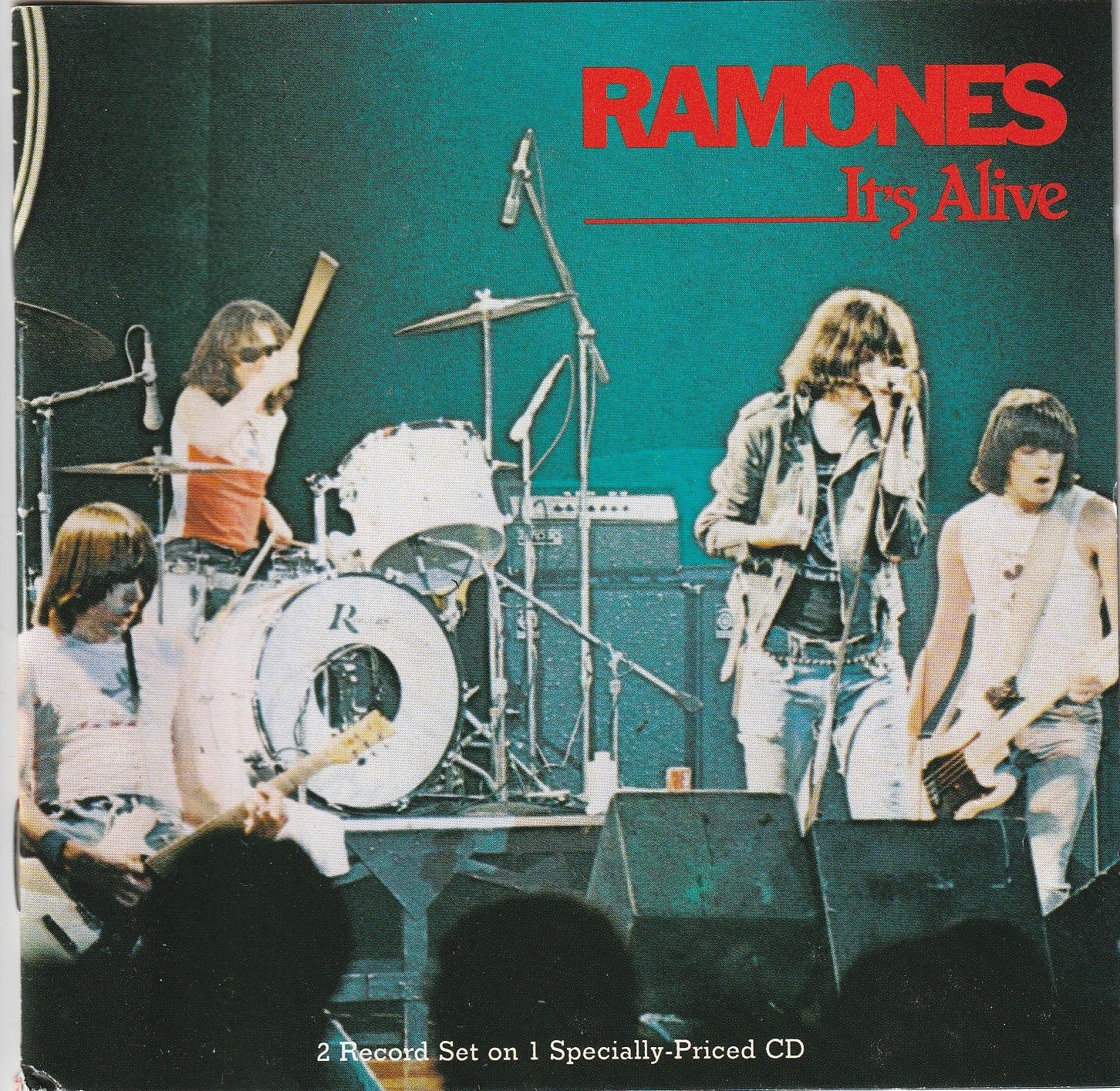
On December 31, 1977, the Ramones recorded It's Alive, a live concert double album, at the Rainbow Theatre, London, which was released in April 1979 (the title is a reference to the 1974 horror film of the same name).
Tommy Ramone tired of touring & left the band in early 1978. He continued as the Ramones' record producer under his birth name of Tommy Erdelyi.
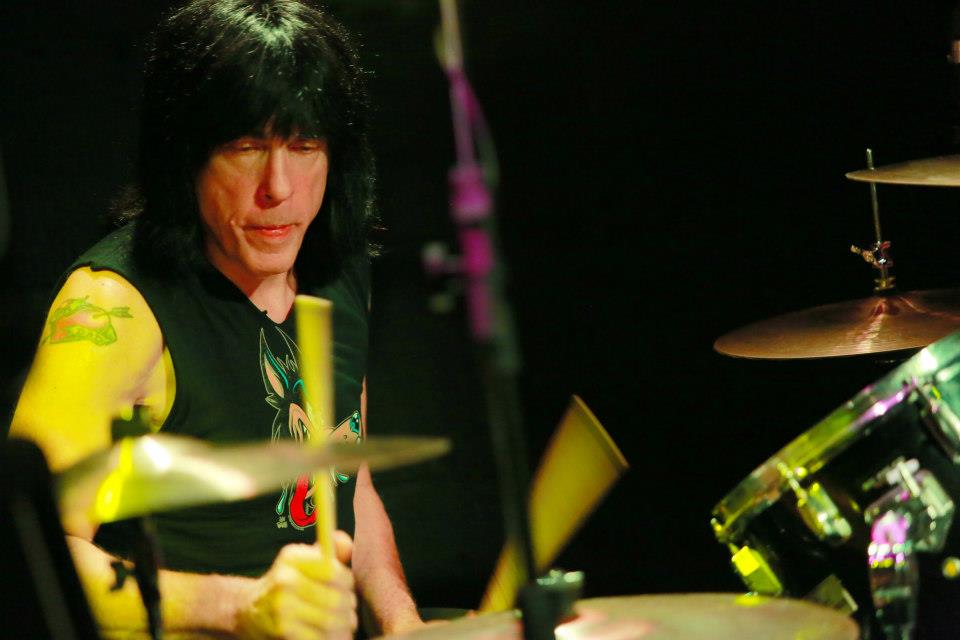
Tommy's position as drummer was filled by Marc Bell, who had been a member of the early 1970s hard rock band Dust, Wayne County, and the pioneering punk group Richard Hell & the Voidoids. Bell adopted the name Marky Ramone.
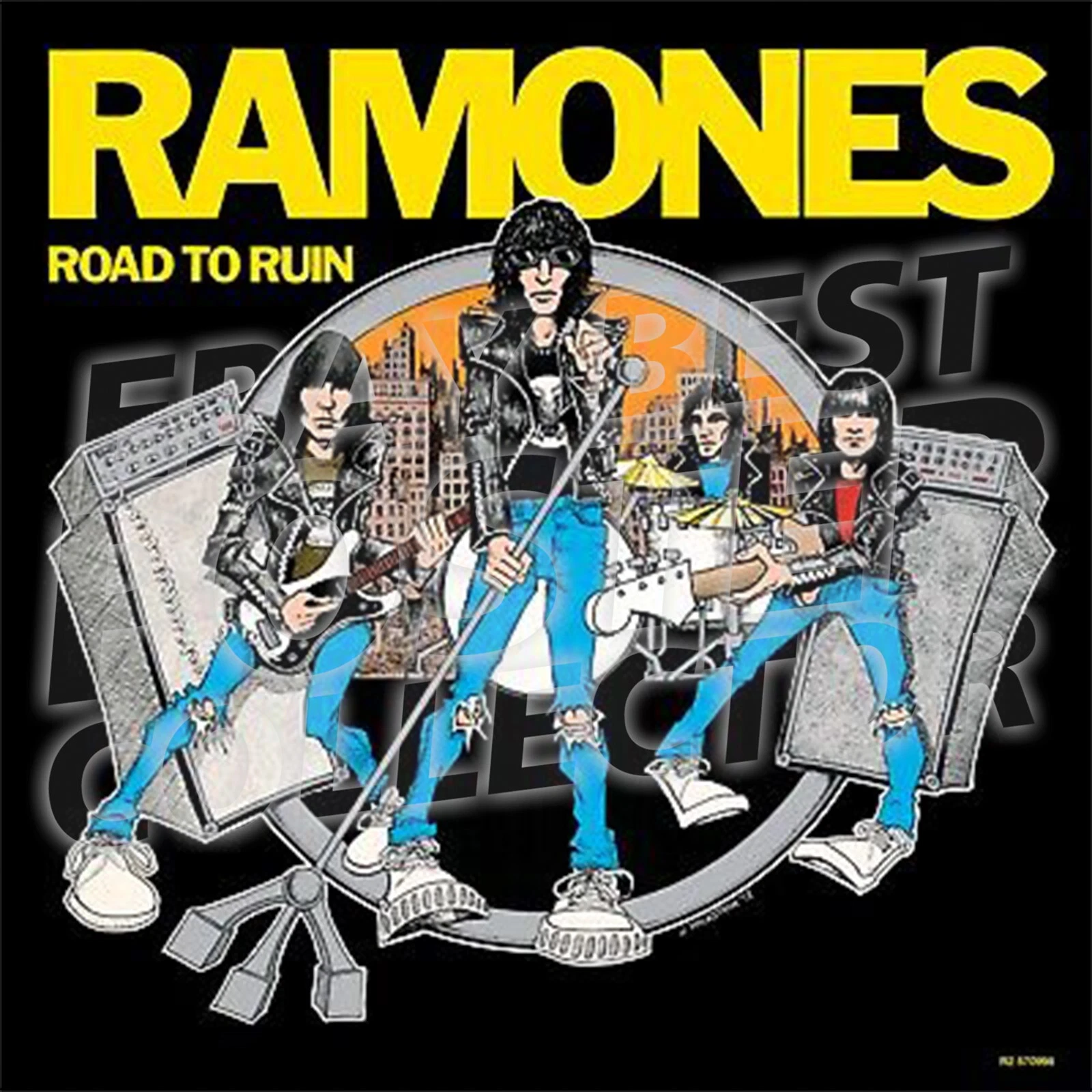
Later that year, the band released their fourth studio album, and first with Marky, Road to Ruin. The album, co-produced by Tommy with Ed Stasium, included some new sounds such as acoustic guitar, several ballads, and the band's first two recorded songs longer than three minutes. It failed to reach the Billboard Top 100.
I Wanna Be Sedated, which appeared both on the album and as a single, would become one of the band's best-known songs. The artwork on the album's cover was done by Punk magazine cofounder John Holmstrom.
After the band's movie debut in Roger Corman's Rock 'n' Roll High School (1979), renowned producer Phil Spector became interested in the Ramones and produced their fifth album End of the Century (1980).

There is a long-disputed rumor that during the recording sessions in Los Angeles, Spector held Dee Dee at gunpoint, forcing him to repeatedly play a riff. Although it was to be the highest-charting album in the band's history—reaching number 44 in the United States and number 14 in Great Britain.
Johnny Ramone made clear that he favored the band's more aggressive punk material: “End of the Century was just watered-down Ramones. It's not the real Ramones.”

Pleasant Dreams, the band's sixth album, was released in 1981. It continued the trend established by End of the Century, taking the band further from the raw punk sound of its early records.
As described by Trouser Press, the album, produced by Graham Gouldman of UK pop act 10cc, moved the Ramones "away from their pioneering minimalism into heavy metal territory". While Pleasant Dreams reached number 58 on the U.S. chart, its two singles failed to register at all.
Subterranean Jungle, produced by Ritchie Cordell and Glen Kolotkin, was released in 1983. According to Trouser Press, it brought the band "back to where they once belonged: junky '60s pop adjusted for current tastes", which among other things meant “easing off the breakneck rhythm that was once Ramones dogma.” Billy Rogers, who had performed with Johnny Thunders and the Heartbreakers, played drums on the album's second single, a cover of the Chambers Brothers' Time Has Come Today, becoming the only song showing three different drummers: Rogers on recording, Marky on album credits and Richie on video clip.
Subterranean Jungle peaked at number 83 in the United States—it would be the last album by the band to crack the Billboard Top 100. In 2002, Rhino Records released a new version of it with seven bonus tracks.
After the release of Subterranean Jungle, Marky was fired from the band due to his alcoholism. He was replaced by Richard Reinhardt, who adopted the name Richie Ramone.
Joey Ramone remarked that “Richie saved the band as far as I'm concerned. He's the greatest thing to happen to the Ramones. He put the spirit back in the band.” Richie was also the only drummer to be the sole composer of Ramones songs including their hit Somebody Put Something in My Drink.
Richie's composition, Somebody Put Something in My Drink, remained a staple in the Ramones set list until their last show in 1996.
The first album the Ramones recorded with Richie was Too Tough to Die in 1984, with Tommy Erdelyi and Ed Stasium returning as producers. The album marked a shift to something like the band's original sound. In the description of Allmusic's Stephen Thomas Erlewine, the “rhythms are back up to jackhammer speed and the songs are down to short, terse statements.”
The band's main release of 1985 was the British single Bonzo Goes to Bitburg; though it was available in the United States only as an import, it was played widely on American college radio. The song was written, primarily by Joey, in protest of Ronald Reagan's visit to a German military cemetery, which included graves of Waffen SS soldiers.
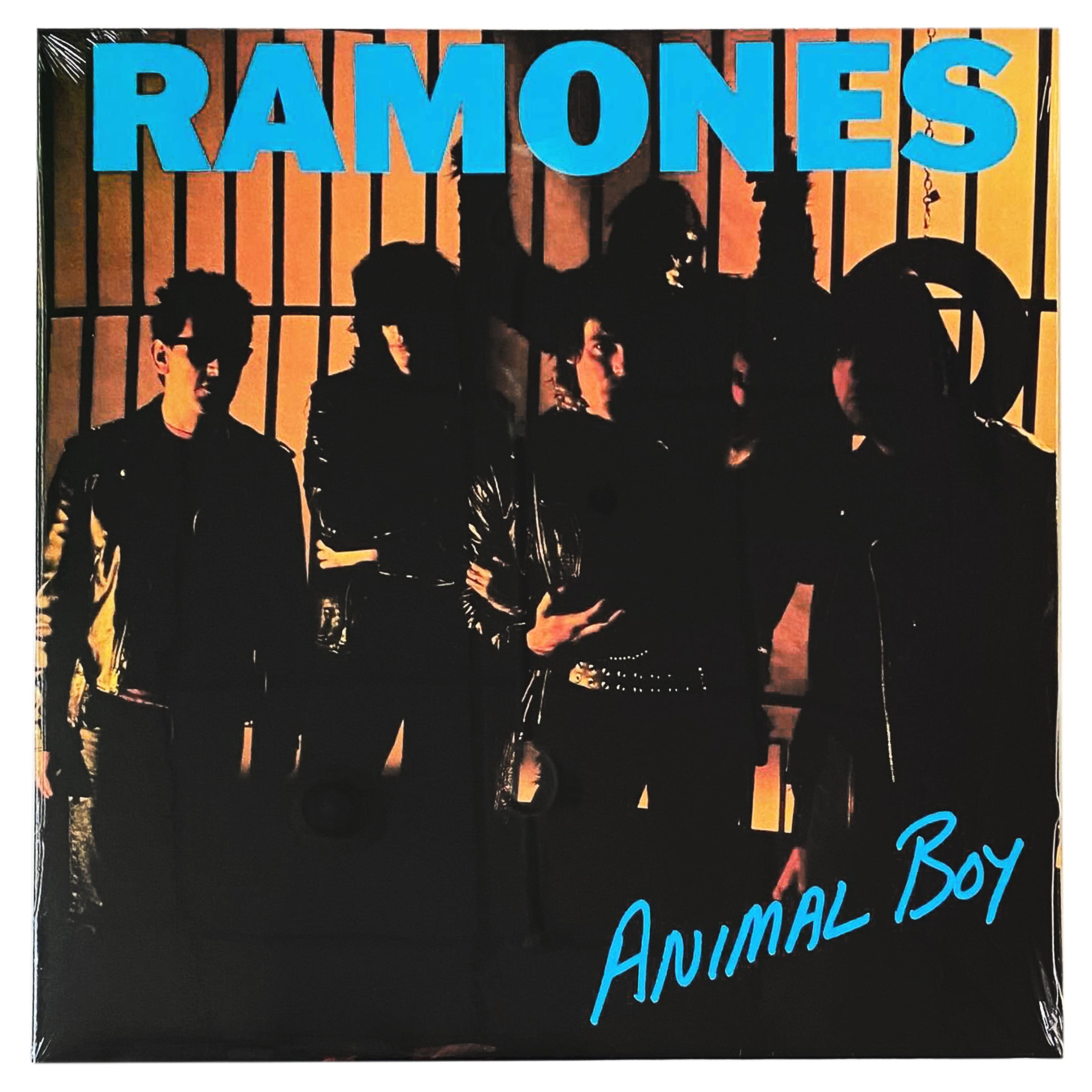
Retitled My Brain Is Hanging Upside Down (Bonzo Goes to Bitburg), the song appeared on the band's ninth studio album, Animal Boy (1986). Produced by Jean Beauvoir, formerly a member of the Plasmatics, the album was characterized by a Rolling Stone reviewer as "nonstop primal fuzz pop".
The following year the band recorded their last album with Richie, Halfway to Sanity. Richie left in August 1987 after financial conflicts with Johnny that centered around him being refused a small percentage of the merchandising money, which had been requested based on his tenure with the band and their use of his name and image.
Richie was replaced by Clem Burke from Blondie, which was disbanded at the time. According to Johnny, the performances with Burke—who adopted the name Elvis Ramone—were a disaster. He was fired after two performances (August 28 and 29, 1987) because his drumming could not keep up with the rest of the band. In September, Marky, now clean and sober, returned to the band.
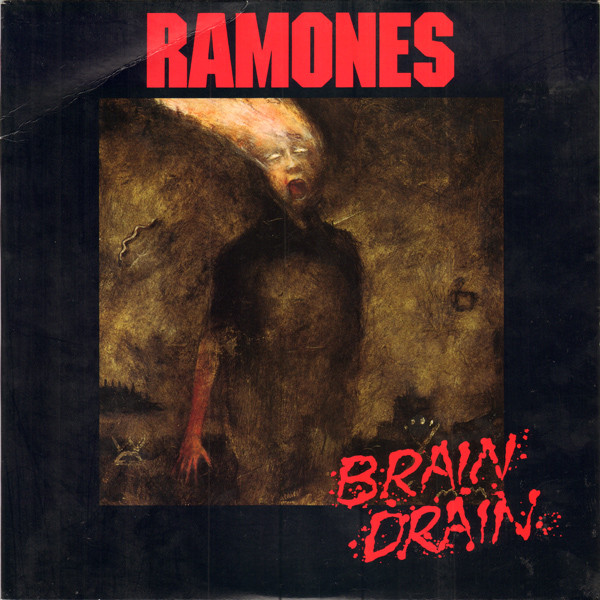
In December 1988, the Ramones recorded material for their eleventh studio album, and what was supposed to be a "comeback" for the band, Brain Drain was co-produced by Beauvoir, Rey, and Bill Laswell. However, the bass parts were done by Daniel Rey and the Dictators' Andy Shernoff.
Dee Dee Ramone would only record the additional vocals on the album citing that members of the band (including himself) were going through personal troubles and changes to the point where he did not want to be in the band anymore.
Although it received mixed reviews upon its release in May 1989, the album included the band's highest-charting hit in America, Pet Sematary.
Despite not wanting to be in the band anymore, Dee Dee (who was sober by this point) was present for the world tour for Brain Drain and played his last show with the Ramones on July 5, 1989, at One Step Beyond in Santa Clara.
Dee Dee was replaced by Christopher Joseph Ward aka C. J. Ramone, who performed with the band until it disbanded.
Dee Dee initially pursued a brief career as a rapper under the name Dee Dee King. He quickly returned to punk rock and formed several bands, in much the same vein as the Ramones. He also continued to write songs for the Ramones, but never rejoined the band.

The band fulfilled their contract with Sire Records in 1991 after being on the label for over a decade and a half, ending with the release of Loco Live.
The band's manager, Gary Kurfurst had just worked out a deal where he was going to get his own record label, Radioactive Records. When CJ Ramone heard Johnny talking about signing to Kurfirst's label, he questioned: “Johnny, you've run this band for years. You carried it all yourself. I don't understand how you don't see the conflict of interest in signing to your manager's label.” Johnny replied: "When you have as many years in the business as I do, then you can make the decisions.".
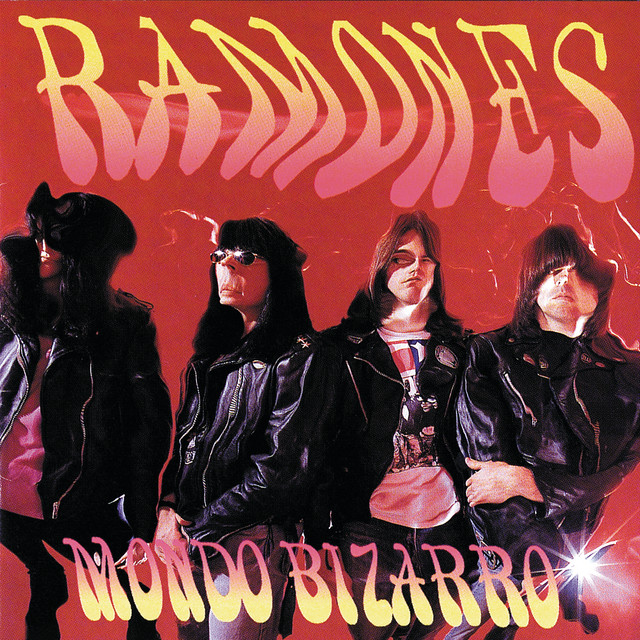
By Johnny's decision, the group ended up signing a new contract with Radioactive Records at the end of that year, the Ramones were soon able to start on sessions for what would become Mondo Bizarro (1992), which saw them reunited with producer Ed Stasium.
Anticipated as a comeback for the band after years of decline in popularity, the album was certified Gold in Brazil after selling 100,000 copies, being the first Gold certification the Ramones were ever awarded, while its lead single Poison Heart was another top ten hit in the US for the band.
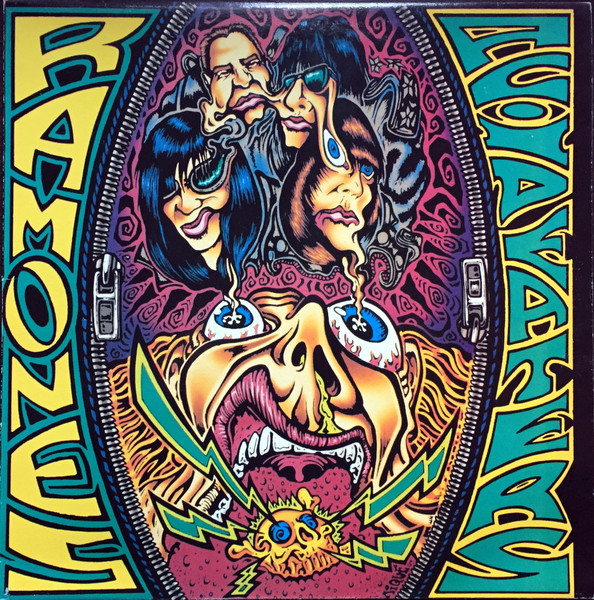
Acid Eaters, consisting entirely of cover songs, came out in 1993. That same year, the Ramones were featured in the animated television series The Simpsons, providing music and voices for animated versions of themselves in the episode Rosebud. Executive producer David Mirkin described the Ramones as “gigantic, obsessive Simpsons fans.” Marky later called their appearance "a career highlight".

In 1995, the Ramones released their fourteenth and final studio album ¡Adios Amigos! and announced that they would be disbanding the following year. The sales of ¡Adios Amigos! were unremarkable, garnering it just two weeks on the lower end of the Billboard chart.
The band spent late 1995 on what was promoted as a farewell tour. However, they accepted an offer to appear in the sixth Lollapalooza festival, which toured around the United States during the following summer.

After the Lollapalooza tour's conclusion, the Ramones played their final show on August 6, 1996, at the Palace in Hollywood. A recording of the concert was later released on video and CD as We're Outta Here!
In addition to a reappearance by Dee Dee, the show featured several guests including Motörhead's Lemmy, Pearl Jam's Eddie Vedder, Soundgarden's Chris Cornell and Ben Shepherd, and Rancid's Tim Armstrong and Lars Frederiksen.
On July 20, 1999, Dee Dee, Johnny, Joey, Tommy, Marky, and C. J. appeared together at the Virgin Megastore in New York City for an autograph signing. This was the last occasion on which the original four members of the group appeared together.
Joey, who had been diagnosed with lymphoma in 1995, died of the illness on April 15, 2001, in New York. Tommy, Richie and C. J. were the only former bandmates to attend his funeral.
Joey and Richie had a close friendship during their time together in the band and the latter expressed sadness over not being able to reconnect with Joey before his death.
On March 18, 2002, the Ramones were inducted into the Rock and Roll Hall of Fame, which specifically named Dee Dee, Johnny, Joey, Tommy, and Marky.
At the ceremony, the surviving inductees spoke on behalf of the band. Johnny spoke first, thanking the band's fans and blessing George W. Bush and his presidency, and America.
Tommy spoke next, saying how honored the band felt, but how much it would have meant for Joey. Dee Dee humorously congratulated and thanked himself, while Marky thanked Tommy for influencing his drum style.
Green Day played "Teenage Lobotomy", "Rockaway Beach", and "Blitzkrieg Bop" as a tribute, demonstrating the Ramones' continuing influence on later rock musicians. The ceremony was one of Dee Dee's last public appearances, as he was found dead on June 5, 2002, from a heroin overdose.
Although The Ramones changed some of their band members along the way, The Ramones would go on to become one of the greatest rock & roll band of all time!

The Ramones performed complete through 1996 and they performed 2,263 concerts over the course of 22 years!
The Ramones (1974-1996) were inducted into the Rock and Roll Hall of Fame at NYC's Waldorf-Astoria (March 18, 2002).

Charlotte Lesher & Mickey Leigh
Johnny Ramone, 53, refused to share the stage with Joey's brother Mickey Leigh, 47, and mom Charlotte Lesher, 75, who were accepting Joey's Rock and Roll Hall of Fame award.
Joey's mom had inherited 50% of Ramones Production Inc (publishing assets) and Johnny controlled the other half, but refused to talk to Charlotte. "I don't have to listen to nobody's brother or mother," Johnny told Village Voice (Mar 12, 2002) in "Punks In The Hall"

Tommy Ramone
Tommy Ramone was the only member of The Ramones who called Joey in his final days at the hospital. Only Tommy and Richie Ramone of the band showed up at Joey's funeral. Only Tommy showed up to Joey Ramone's 50th Birthday Bash, a posthumous tribute on May 19, 2001.
1978-83 Ramones drummer Richie Ramone and 1989-96 Ramones bassist CJ Ramone were ruled ineligible to be inducted.
The Hall then informed Mickey and Charlotte, due to a scheduling mistake, they could not go up separately. They could only go "with" The Ramones then.
Tommy acknowledged Ramones roadie Monte Melnick, Ramones art director Arturo Vega and CBGB (1973-2006) founder Hilly Kristal.
Tommy went through Ramones historical figures: He noted Ramones producers Phil Spector, Daniel Rey, Ed Stasium and Tony Bongiovi. He acknowledged CJ Ramone for keeping the band young. He thanked CBGB peers like Television, Patti Smith, Blondie and Talking Heads and influences like MC5, Lou Reed, Andy Warhol, New York Dolls, Iggy Pop and The Stooges, for co-creating the scene.
Tommy said of The Ramones: ""Believe or not, we really loved each other, even when we weren't acting civil to each other. We were truly brothers. The honor of our induction to the Hall of Fame means a lot to us but it really meant everything to Joey."

LONG LIVE JOEY RAMONE
In 1985 Joey Ramone participated in the Artists United Against Apartheid project Sun City and has also guested with Youth Gone Mad, Helen Love and Diné-Navajo rock band Blackfire.
Other projects included managing horror-punk band The Independents and he produced Ronnie Spector's She Talks To Rainbows album.

Joey died at 49, but not before becoming a true NYC rock icon.

ROCK & ROLL IS A STATE OF MIND
AMEN!

ALBUMS
COMPACT DISCS
BUMPER STICKERS
BUTTONS
& MORE!
BACK TO ALL BLOG POSTS