
THE NEVILLE BROTHERS OF NEW ORLEANS
Tipitina’s is in the warm blue fog beneath a Louisiana moon which is so sharp that you could shave a wild hog with that blue fog.
Art Neville enters the famous New Orleans honky-tonk wearing a hipster’s suit and studded leather boots, his wife, Lorraine, in hand. At 53, Art Neville is the oldest member of the Neville Brothers, a hometown band legendary for the kind of musical voodoo it practices on whoever comes to catch its midnight show.
Whenever The Nevilles play @ Tipitina’s and a spooky magic happens: Fruit juice becomes a Hurricane cocktail.
Like his three brothers, Art, the Nevilles’ keyboard player, has his thing on the side—the Meters, the band he took to Europe. Saxophonist Charles has a jazz group called Charles Neville & Diversity; Cyril, the percussionist, has a funk-reggae outfit called the Uptown All-Stars; and Aaron, the one with the golden pipes, has himself.
Art says "it's been four, five, months maybe, since we played Tipitina’s but I don’t know how long it’s gonna go tonight. The Nevilles start at midnight and they probably play until around four am. In the old days it sometimes was daylight before the Nevilles got out of here.”
Downstairs, a band called Def Generation, composed mostly of Neville progeny, is killing the hour before the brothers come on. The opening act, their sound is part jazz, part rap, part second line, the bluesy brass-band music that traditionally accompanies black funeral processions through the streets of New Orleans.
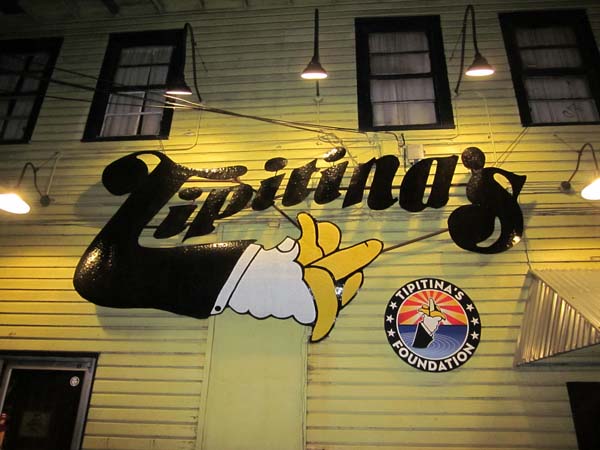
Tipitina’s opened about fourteen years ago, the same year the Neville Brothers formed. Named after a song by the late New Orleans pianist Professor Longhair, the club was started by a group of folks who liked to party hard and “gator.” To the uninitiated, gatoring is a dance that imitates coitus: It’s dry humping to a drumbeat. But to these people, it’s a religious rite ranked right up there with First Communion—or Mardi Gras.
The Nevilles played their first gig at Tip’s, to an audience that gatored so long and furiously, the beer lights dimmed and dust rained loose from the walls.
The Nevilles music, inspired by the ancestral rhythms of their city, is mostly pop, funk, and soul. One moment they’re likely to sing an original composition about wild Injuns or yellow moons, the next a Cole Porter standard or The Mickey Mouse Club song. A rap anthem lamenting racism and urban violence might follow, or maybe some gospel bit rarely heard even in church anymore. Their repertoire apparently knows no limits, nor does their energy onstage. While the debut at Tip’s is now regarded as damned near mythic, few people actually remember it. Most everyone, I understand, was drunk or stoned.
There's a commotion in one of the dressing rooms. On a wall already covered with graffiti, someone has written “AARON NEVILLE WEARS PANTYHOSE.” A couple of ladies, standing on tiptoe, are scribbling over it with eyeliner and lipstick.
If Aaron Neville wears pantyhose, then I go for those pointy Madonna bras with little link chains hanging from the nipples. Aaron is a devotee of professional wrestling who drives an all-terrain vehicle and sports tattoos on his face, chest and arms—arms that from any angle resemble dimpled Sunday hams without the honey glaze.
In 1967, Aaron Neville had a hit song called “Tell It Like It Is,”
…and two summers ago he scored big with Linda Ronstadt on “I Don’t Know Much,” a Grammy award-winning ballad that in one clean stroke seemed to resurrect the Neville name from oblivion. In the more than twenty years between the two hits, Aaron managed to pull a couple of hitches in jail, for attempting to rob a Los Angeles furrier.
Tonight he’s dressed all in black, except for his white half boots. He walks around muttering “Yeah, all right” to all the friends and family members who have come to celebrate the band’s triumphant return to Tipitina’s. He hugs his sister, Athelgra, hugs his daughter, Ernestine, hugs his niece Arthel.
Apparently Aaron is in no mood for business cards. He accepts the token without looking at it, brushes past the man and walks right by the painted-over pantyhose rap. He enters a back room, sits at a round café table and sips from a bottle of mineral water. A curtain of smoke billows a few feet above his head, hugging the ceiling. In a minute he’ll yodel like the singing cowboys in the movies he loved so much as a kid. This, while limbering up his voice box, also demonstrates his range, which, in the idolatrous prose of more than one music critic, sounds like that of “an angel singing unto the Lord.”
A friend of the group’s is telling me that it’s part of the mystique—like they could blow down the walls if they wanted to. But they’re really nice men.
Before they cleaned themselves up, the Nevilles were thieves, thugs, and junkies. Practically everyone here tonight knows this, and most are delighted by it. The music is always best heard live, and though it would be great played by a bunch of priests from nearby Loyola University, coming from a clutch of reformed outlaws it takes on an element of mystery and danger.
Except for Art, the Nevilles were heroin addicts and alcoholics—hoodlums, even they have often said. Back in the neighborhood, it was not uncommon to see one of them on any given weekday morning sitting on the hood of a junked car, holding a gallon jug of high-proof wine. They fought a lot and stole things. They dressed like rogue gangsters and talked through tightly clenched teeth.
“Why didn’t Art mess up like all the others?” one of his pals is saying. “Because he was far too busy playing his music and screwing women is why.”
Charles walks over to the corner and loosens up with some T’ai Chi Ch’uan exercises, Cyril’s making sure his Mother Africa outfit is all zipped and tucked, and Art, still full of midnight turkey, tries to keep from falling asleep.
“Showtime!” a yellow ponytail says now with more zeal than seems necessary.
Aaron stands and tugs at the bottom of his denim vest. “Yeah, all right,” he mutters, then follows his brothers out of the room, down a rickety flight of stairs and into the crucible.
Later on the Neville Brothers end up staying in a Los Angeles hotel just up the street. This is one of those incredibly hip places that looks like a low-rise apartment building.
The Nevilles have come to town to play the Universal Amphitheatre as Linda Ronstadt’s opening act. This is high irony, that four hardened soldiers of the street have been embraced by a fading pop queen, but apparently yuppie chic knows no shame.
The rooms for the Neville Brothers are set up on the 3rd floor. Charles is wearing his usual beret, tie-dyed T-shirt and parachute pants. Charles is 52 and a great-grandfather, which in terms of simple mathematics is quite a feat. He has just finished relating the part about how he worked for a time as a porter in a bowling alley and how in the early 1970s he spent three years in the Louisiana state pen for possession of two joints of marijuana.
The phone rings and Art’s in room 346, talking to a maid in a neatly pressed uniform and a cardboard hat. For the last hour or so she’s been trying to get into his room to clean it.
“Come back later,” he tells her. Then to me: “They’re just trying to do their job, I understand that. But I think I’ve finally learned how to keep them away.”
“How’s that?”
“Just answer the door without any clothes on. That’ll do the trick every time.”
Art starts talking about the band's various trips to Europe.
“In Europe, they always went insane over our stuff. But here in America, no one would book us, except in Louisiana and Texas. We had a gold record in France and were practically unknown here.”
Art started a group called the Hawkettes, which in 1954 recorded “Mardi Gras Mambo,” a song still popular around New Orleans. In 1966, he formed the Meters, a hometown group that recently re-banded and is touring again. Art isn’t quite sure whether to trust the good fortune that has finally caught up to him and his brothers.
Art says that “in Europe, they always went insane over our stuff,” he says. “But here in America, no one would book us, except in Louisiana and Texas. We had a gold record in France and were practically unknown here. Even Japan paid more attention. Once we played in Seattle, and this Japanese group was there, and it sounded just like the Meters.”
Art calms down. He’s sounding more optimistic. “If I had to say what really got the Neville brothers to be a group,” he begins, “it’s our Chief Jolly, our uncle George Landry. He knew that if we got together as a family, it would happen. They called him Jolly because he was always happy, singing and whistling. When he died, all the black Mardi Gras Indians came out and kissed the ground in front of his house. He had one of the biggest funeral parades I’ve ever seen. I’ve got it in my head that I’m going to have one before I die—a second line, I’m talking about. That’s if I can afford it. I’ll be up in front with an umbrella, dancing. I figure you just as soon live to see your own funeral. If the end’s coming, why not have some fun?”
Brother Cyril dresses a little like a Rastafarian and almost always wears a hat, an expensive Italian job with a black velvet band and a red feather. While the hat is the kind Uncle Jolly used to wear, it also covers up Cyril’s ever expanding bald spot.
Yellow Moon, the Neville Brothers’ 1989 album, includes a song he helped write thanking Rosa Parks for refusing to sit in the back of the bus. Brother’s Keeper, their latest, contains a creation of his that canonizes a list of New Orleans musicians whose work inspired him and his brothers: “Saint Shine, Saint James Black, Saint James Booker, Saint Professor Longhair and Saint Gerald Tillman.”
Aaron, down the hall, is in a different mood altogether. He looks as if I’ve just awakened him from a nap.
Earlier this morning Aaron and his wife, Joel, went driving around Beverly Hills, looking at all the beautiful houses, the palm trees that chase the sky. They themselves recently moved from Valence Street in Uptown New Orleans to a suburban-type subdivision in the eastern part of the city.
Asked if, like Cyril, he was harassed and humiliated as a kid, Aaron says, “Some drunk boys from Tulane threw eggs a few times, riding in their cars through the neighborhood, but nothing else I remember.”
He sits with his elbows on his knees, his jailhouse tattoos a pale blue against the field of copper flesh. Aaron wears sleeveless denim vests because he can’t stand to have his muscular arms confined. Of the four brothers, Aaron, 50, is easily known, mainly because of his work with Ronstadt.
“Success to me,” Aaron is saying now, “is being together as brothers and still looking out for each other. We lived together as kids, and now we’re taking care of each other as men. I may get more attention than them, but it’s still Neville, it’s still the Neville name.”
Aaron says, “Singing is an art so I guess I’m an artist. I used to sing just to do it, but then Art put together a doo-wop group. They used to sit out in the park and harmonize. I’d do a cappella. We’d beat on hubcaps and Coke bottles. We’d win talent shows at the theater.”
When Aaron was 17, he went to jail for six months for stealing a car. He sang a lot there, too, figuring it was better than the other thing people did to kill time, which was to fight. After he got out, he married Joel and landed a recording contract. Then, in 1966, he cut “Tell It Like It Is,” at a small French Quarter studio run by a fellow named Cosima Matassa.
Aaron remembers when he began to sing. “When I first sang it, I thought it was okay but not the best I could do. It was a simple song, real simple. And I was looking for something more up-tempo. But my brother Art was with me and he could feel it. He knew I had something. Now when I hear it, it’s like brand-new all over again.”
The single climbed to No. 2 on the charts. Aaron toured the country with Otis Redding and played the Apollo Theater in Harlem. But a year later he was back home in New Orleans and back on the docks, handling freight on ships bound for the Gulf of Mexico.
Aaron and his brothers continued to play music in a number of different bands—sometimes together, sometimes apart—mostly at college fraternity parties and high school proms, before small but enthusiastic crowds whose applause only served to remind Aaron that, come Monday, there would be another boat to load or house to paint or ditch to dig.
Like Charles before him, Aaron got hooked on heroin. “The worst time of my life was when I was separated from my wife and thought I would lose her. Then I started praying real hard. I’d go to the grotto at St. Ann’s Shrine. This is where you go up the steps on your knees. I prayed to St. Jude for hopeless cases. I made novenas. Finally, I was saved, and I can tell you it wasn’t for nothing.”

The Nevilles’ mother died in 1975, and about a year later Uncle Jolly talked them into helping him record The Wild Tchoupitoulas, an album of New Orleans party music that still is regarded as some of the best work the brothers have ever done.
Of the many things old man Jolly would tell his nephews, none was more vital than this: “Your mother and father always wanted to see you work together as a band. Why don’t you do it?”
Back at Tipitina’s, the brothers step onto the little piece of ground they know best, entering with arms raised. A man with a bushy black mustache is shouting into a microphone “Welcome back to Tipitina’s”—but the crowd, pressing close, drowns out the rest.
Sleepy-eyed Art gets behind his piano, Charles behind his horseshoe of saxophones, Aaron behind his mighty red tambourine and Cyril behind his congas. “Hey Pocky A-Way” is what they start with, a local favorite that Uncle Jolly helped make famous. The song is mostly chants accompanied by whatever noise the brothers choose to make, but it electrifies.
AND THE BAND PLAYS ON!
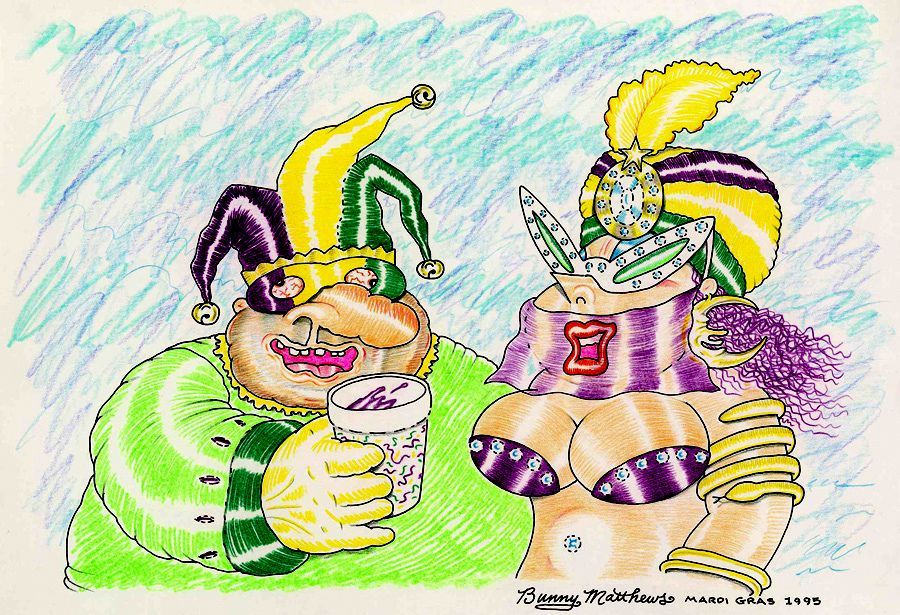
IT'S MARDI GRAS WEEK!


Jim says
“It's time for some tasty Mardi Gras!”